
Leopard Gecko Care: The Complete Beginner's Guide to a Thriving Gecko
Posted by The Fluker's Team on Aug 2nd 2026
Leopard gecko care is often described as easy, and compared to most reptiles, it is. They're docile, they tolerate handling, they don't need specialized UVB lighting in most setups, and they live 15–20 years on a straightforward diet of feeder insects. But "easy" doesn't mean "casual." Most of the leopard gecko problems we see, slow growth, refusal to eat, prolapses, metabolic bone disease, come from a few specific mistakes new keepers make in the first six months.
This guide covers leopard gecko care from enclosure selection through long-term diet, with the husbandry details that prevent the avoidable problems.
Quick Facts About Leopard Geckos
- Scientific name: Eublepharis macularius
- Native range: Arid grasslands of Afghanistan, Pakistan, northwest India
- Adult size: 7–11 inches including tail
- Lifespan: 15–20 years (some reach 25+)
- Activity: Crepuscular (most active at dawn and dusk)
- Temperament: Generally docile, tolerates handling well
Enclosure Setup
A single adult leopard gecko needs a minimum 20-gallon long (30" x 12" x 12") tank, but a 40-gallon breeder (36" x 18" x 18") lets you create proper temperature gradients and multiple hides.
Substrate
This is where most beginner mistakes happen. Safe substrates:
- Paper towels (best for juveniles and quarantine)
- Slate tile or ceramic tile (clean, helps file nails)
- Bioactive soil mix (advanced; deep substrate with a cleanup crew)
Avoid walnut shell and crushed corn cob. These cause impaction and have killed thousands of leopard geckos. Despite what some pet store displays show, sand is not a safe substrate for leopard geckos — Reptifiles, the Association of Reptilian and Amphibian Veterinarians, and most modern care references all agree on this.
Hides
Leopard geckos need three hides:
- A warm hide on the warm side of the tank
- A cool hide on the cool side
- A humid hide in the middle, with damp sphagnum moss inside for shedding
The humid hide is non-negotiable. Without it, shedding problems and stuck shed around the toes lead to amputation over time.
Temperature and Heating
Leopard geckos thermoregulate via belly heat. They need a temperature gradient:
- Warm side surface temp: 88–92°F
- Cool side ambient: 70–75°F
- Nighttime drop: down to 65–70°F is fine
Use a heat mat under one third of the tank controlled by a thermostat. Overhead ceramic heat emitters work too. Avoid heat rocks as they will cause belly burns. A digital infrared thermometer is essential; bulb thermometers stuck on the glass give you air temp, not belly temp.
Lighting and UVB
For decades, leopard geckos were considered nocturnal and not in need of UVB. Modern research has changed that view. Crepuscular activity means they do encounter UVB exposure in the wild, and low-level UVB (5.0 bulb on a 12-hour cycle) supports calcium metabolism and is increasingly recommended.
UVB isn't mandatory if you supplement with vitamin D3, but it's a meaningful upgrade. Replace bulbs every 6–12 months — they produce visible light long after the UVB output drops.
Diet and Feeding
Leopard geckos are pure insectivores. They eat live insects only. No fruit, no veg, no pelleted reptile food.
Staple Feeders
- Crickets — classic staple, easy to find, good size variety
- Mealworms — high palatability, easy to store, slightly fatty
- Dubia roaches — best calcium: phosphorus ratio of common feeders, very high meat-to-shell ratio
- Superworms — high fat, occasional treat for adults only
Treat Feeders
- Hornworms — hydrating, good for picky geckos
- Black soldier fly larvae — natural calcium source
- Waxworms — very fatty, use sparingly
Feeding Schedule
- Hatchlings (0–4 months): Daily, 5–7 small insects per feeding
- Juveniles (4–12 months): Every 1–2 days, 6–8 insects per feeding
- Adults (12+ months): Every 2–3 days, 6–10 insects per feeding
Feed in the evening to match their crepuscular activity. Stop feeding any insect bigger than the space between the gecko's eyes — impaction is a real threat.
Gut Loading and Calcium
Water
Gut load all feeders 24–48 hours before feeding (greens, vegetables, calcium-rich foods). Dust with calcium powder at every feeding. Use calcium with D3 if your gecko doesn't have UVB; calcium without D3 if it does.
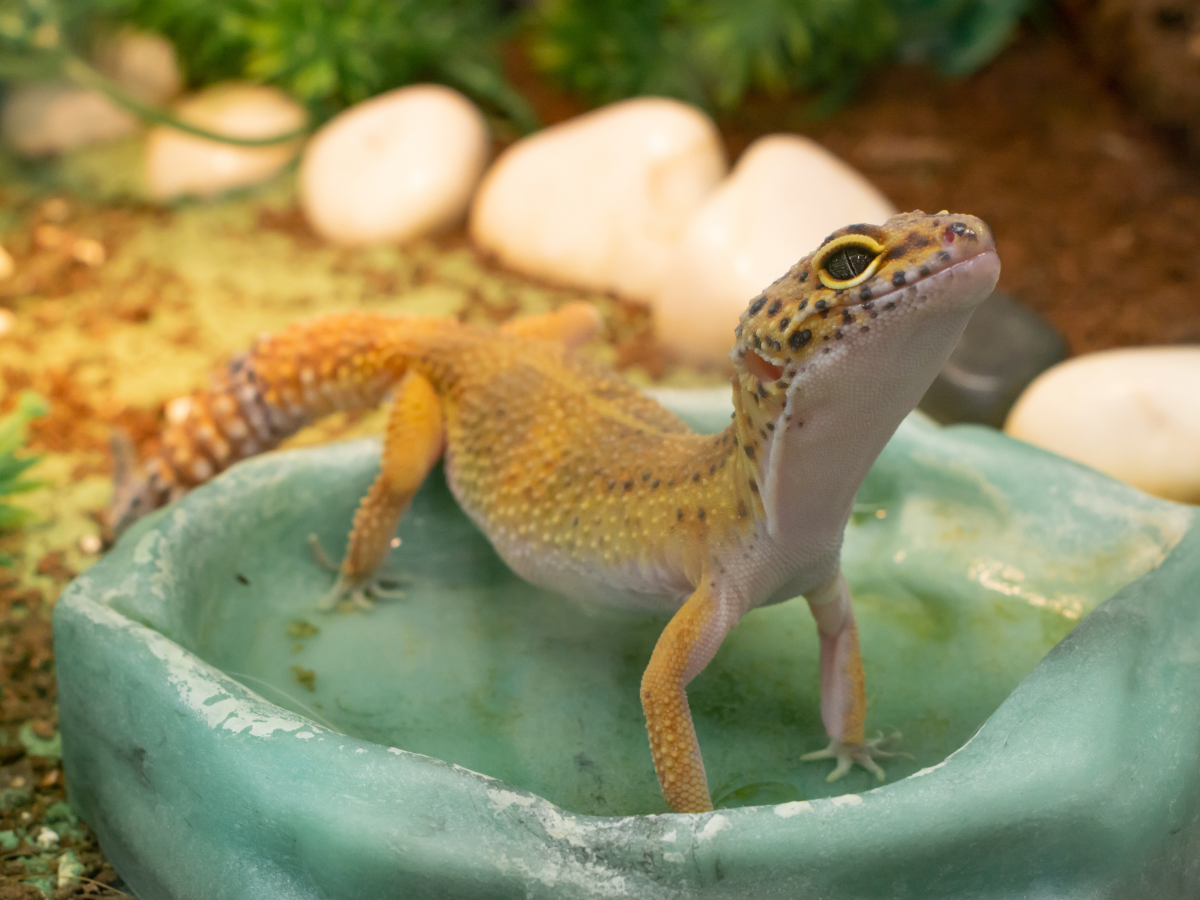
A shallow, sturdy water dish on the cool side, refreshed daily. Leopard geckos drink less than you'd expect, but the humidity from the dish supports shedding.
Handling
Leopard geckos generally tolerate handling well once they're settled (give new geckos 1–2 weeks of zero handling to acclimate). Keep sessions short — 10 minutes — and support the body. Never grab by the tail. Tail drops are a defense mechanism; the tail regrows but the new one looks different and represents lost energy and fat stores.
Shedding
Leopard geckos shed every 2–4 weeks, faster as juveniles. Signs:
- Skin turns dull or pale gray
- Eyes look cloudy
- Reduced appetite for 1–2 days
Fun fact: they eat their shed! This is normal and recycles nutrients. Stuck shed around the toes is the most common shedding problem. Check toes after every shed; if shed remains, soak in shallow lukewarm water for 10 minutes and gently remove.
Common Health Issues
Metabolic Bone Disease (MBD)
The number one preventable killer. Caused by calcium deficiency. Symptoms: kinked tail, soft jaw, lethargy, tremors. Prevention: gut load feeders, dust calcium with D3, consider UVB.
Impaction
Usually from loose substrate or feeders that are too large. Symptoms: bloating, refusal to eat, no defecation. Prevention: solid substrate, correctly sized feeders.
Cryptosporidiosis
A parasitic infection causing wasting, especially the "stick tail" appearance. Often introduced from non-quarantined new geckos. Quarantine new arrivals 60–90 days minimum.
Mouth Rot (Stomatitis)
Bacterial infection of the mouth, often secondary to husbandry issues. Symptoms: drooling, swelling, refusing food. Requires vet treatment.
Quarantine and New Geckos
Any new gecko should be quarantined separately from existing collection for at least 60 days. A different room is best. Watch for parasites, refusal to eat, and abnormal stools.
Frequently Asked Questions
Are leopard geckos good for beginners?
Yes, they're one of the most beginner-friendly reptiles, with simple diet requirements, manageable size, and tolerant temperament. They still need proper husbandry; they aren't no-effort pets.
Can I house two leopard geckos together?
Generally no. Two females sometimes work; two males almost never. Even compatible pairs need to be monitored closely and given enough space and resources. Solitary housing is safer.
How often should I feed my leopard gecko?
Juveniles daily, adults every 2–3 days. Adjust based on body condition, a healthy gecko has a plump tail roughly as wide as the neck.
Do leopard geckos need UVB?
Not strictly required if you supplement D3, but increasingly recommended. Low-level UVB (5.0 bulb) improves long-term health and calcium metabolism.
What's the best feeder insect for leopard geckos?
Dubia roaches edge out crickets on calcium-to-phosphorus ratio and meat content. Mealworms are easier to manage. A rotation of all three plus occasional hornworms gives the most balanced nutrition.
How long do leopard geckos live?
15–20 years on average. Well-cared-for geckos regularly hit 22–25 years. This is a real commitment.
Final Take
Leopard gecko care is straightforward but unforgiving of shortcuts. Solid substrate, three hides including a humid one, proper belly heat with a thermostat, gut-loaded and calcium-dusted feeders, and patience with handling new arrivals — those five things solve 90% of the problems we see.
Fluker Farms has supplied feeder insects to leopard gecko keepers for over seven decades. Our live crickets, mealworms, and dubia roaches ship farm-fresh from Louisiana, and our reptile care sheets cover species-specific feeding and husbandry in greater depth.