
Feeder Insects for Reptiles: A Complete Comparison Guide
Posted by Fluker's Team on Nov 4th 2026
Choosing feeder insects for a reptile can get confusing easily. Crickets, dubai roaches, mealworms, superworms, hornworms, and black soldier fly larvae all have different nutritional profiles and none of them should be treated as a complete diet on their own.
The good news is that you don’t need to make it complicated. A combination of appropriate feeders, proper gut loading, and the right supplements can provide a well-rounded diet for most insect-eating reptiles.
Here’s a look at some of the most common feeder insects, how they differ and where each one fits into a feeding rotation.
The Calcium Problem
One of the biggest nutritional challenges with feeder insects is calcium. Many commonly used feeders contain more phosphorus than calcium, so feeding them without supplementation can leave reptiles short on calcium over time.
Calcium is especially important for growing reptiles and preventing metabolic bone disease. Proper supplementation, along with appropriate UVB exposure required for the species, is an important part of reptile husbandry.
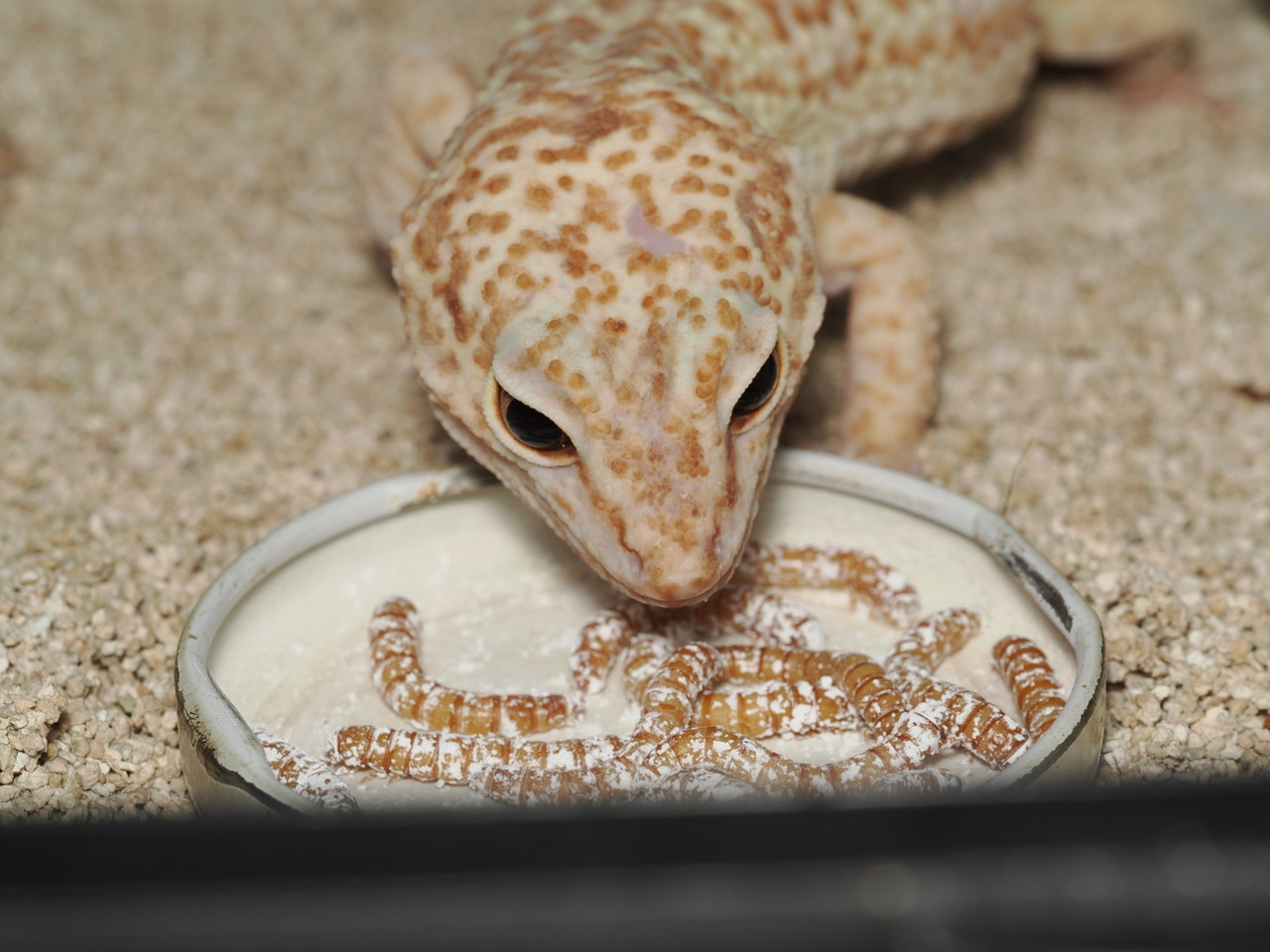
Dusting- Coat feeders in a calcium powder immediately before offering them. Most keepers use plain calcium at most feedings and a calcium-with-D3 or multivitamin product on a schedule appropriate to the species and its UVB exposure.
Gut loading- Feed the insects a quality diet for 24 to 48 hours before they go in the enclosure. A cricket is largely a bag of whatever it last ate.
Black soldier fly larvae are the notable exception because they carry a naturally favorable calcium ratio, which is why they have become popular as a staple.
Feeder Insect Comparison
Nutritional values can vary depending on the insect’s diet, and age. Below the table shows the value of protien, fat, and calcium based on the speices.
|
Feeder |
Protein |
Fat |
Calcium |
Role |
|
Crickets |
High |
Moderate |
Low, needs dusting |
Staple |
|
Dubia roaches |
High |
Moderate |
Low, needs dusting |
Staple |
|
Black soldier fly larvae |
Moderate |
Moderate |
Naturally high |
Staple |
|
Mealworms |
Moderate |
High |
Very low |
Supplemental |
|
Superworms |
Moderate |
High |
Very low |
Supplemental |
|
Hornworms |
Moderate |
Very low |
Moderate |
Hydration / treat |
|
Waxworms |
Low |
Very high |
Very low |
Occasional treat |
|
Hissing cockroaches |
High |
Moderate |
Low |
Large species only |
The Staples
Crickets
Crickets have been the go-to feeder for years. They are active, which triggers a feeding response in nearly every insectivore; they are available in every size from pinhead to adult; and they gut load readily. Protein is solid and fat is moderate.
Their biggest drawbacks are practical rather than nutritional. Crickets are noisy, prone to escaping if housed incorrectly. Poorly maintained crickets can smell. Keepers who manage a properly ventilated container with egg crate flats rarely have problems
For keepers who don’t mind managing them, crickets remain a useful staple feeder.
Shop live crickets in every size.
Dubia Roaches
The staple of choice for keepers who want low maintenance. Dubia are quiet, cannot climb smooth surfaces, cannot fly well, and do not produce the odor crickets do. They are meatier than crickets per unit, with a softer shell than many roach species, and they breed readily if you want a self-sustaining colony.
The main downside is that they are slow-moving and will burrow, which some visually driven feeders find uninteresting. Feeding from a smooth-sided dish solves this.
Browse dubia roaches.
Black Soldier Fly Larvae
Black soldier fly larvae, sometimes sold as soldier worms or calciworms, are also a popular feeder. Their standout feature is a naturally favorable calcium-to-phosphorus ratio the only common feeder that does not fight you on calcium. They are soft-bodied, do not bite, do not escape easily, need no refrigeration, and require essentially no care.
They do not move much, so some animals ignore them at first. Offer in a dish and most reptiles come around.
Browse black soldier fly larvae.
The Supplementals
Mealworms
Mealworms are one of the easiest feeders to store and use. They are inexpensive, convenient, and can be kept refrigerated for extended periods of time.
They are also high in fat relative to protein when compared to other feeders. Their hard exoskeleton makes them less appealing as a sole feeder for some smaller reptiles.
This dosent make them a bad feeder. They are convenient addition to a varied diet and work well for animals that enjoy chasing their prey.
Browse live mealworms.
Superworms
Superworms are larger and softer than mealworms with a similar nutritional profile — more fat than a staple should have. Excellent for adult bearded dragons, larger geckos, monitors, and skinks. They are active enough to hold the interest of picky eaters, which makes them useful for coaxing an animal back onto food.
They are also relatively high in fat, so they generally work better as part of a rotation rather than the only insect you feed your pet.
Superworms should not be refrigerated; cold kills them. Keep at room temperature in bran.
Browse live superworms.
Treats and Specialty Feeders
Hornworms
Hornworms are very high in moisture and low in fat which makes them useful when you want to add hydration and variety to a reptile’s diet.
Hornworms are the go-to for a dehydrated animal, a reptile recovering from illness, or a bearded dragon that needs the water content. Their bright green color makes them highly visible and they are rarely refused.
They are not the foundation of a diet, but can be a useful addition to a feeding rotation.
Browse live hornworms.
Waxworms
Think of waxworms as candy. Extremely high fat, low protein, low calcium, and highly palatable to the point that some animals will refuse other food after a run of them. Use sparingly, such as for medicating, for tempting a reluctant feeder, or as an occasional reward for an underweight animal under veterinary guidance.
Madagascar Hissing Cockroaches
Large, slow, and long lived. Appropriate for tegus, monitors, large skinks, and big frogs. Too large for most common pet lizards.
Browse hissing cockroaches.
Building a Feeding Rotation
A workable pattern for a typical insectivorous lizard:
-
- Choose two staples and alternate them. Crickets and dubia is the classic pairing. Crickets and black soldier fly larvae works well if you want the calcium advantage.
- Add a supplemental once or twice a week. Mealworms or superworms that are sized appropriately.
- Add a treat occasionally. Hornworms when hydration matters, waxworms rarely.
- Dust with calcium at nearly every feeding, with D3 or multivitamin on the schedule your species requires.
- Gut load everything for 24 to 48 hours beforehand.
Sizing rule throughout: no feeder wider than the space between the animal's eyes.
Frequently Asked Questions
What is the best all-around feeder insect?
For most keepers, dubia roaches or crickets as the base, with black soldier fly larvae rotated in for calcium. No single insect is complete on its own.
How often should I dust feeders with calcium?
This is species-dependent. Many keepers dust with plain calcium at most feedings for growing animals and slightly less often for adults, with D3 or multivitamin on a separate weekly or biweekly schedule. Species with strong UVB exposure need less dietary D3. Follow a care sheet for your specific animal or ask an exotics veterinarian.
Can I feed wild-caught insects?
We advise against it. Wild insects can carry pesticides, parasites, and pathogens, and some species are toxic. Captive-bred feeders are the safe path.
Why won't my reptile eat black soldier fly larvae?
They do not move much, and some animals are cued by motion. Offer them in a shallow dish, try them when the animal is hungry, and mix them with a moving feeder at first.
Do feeder insects need to be gut loaded even if I dust them?
Yes. Dusting corrects calcium. Gut loading improves the overall nutritional content of the insect itself. They do different jobs.
Shop Feeder Insects
Browse the full range of live feeder insects at Fluker Farms; crickets, dubia roaches, mealworms, superworms, hornworms, and black soldier fly larvae, raised on our own Louisiana farm since 1956.